
Where Does Interstellar Space Begin?


Where Does Interstellar Space Begin?

What is interstellar space?
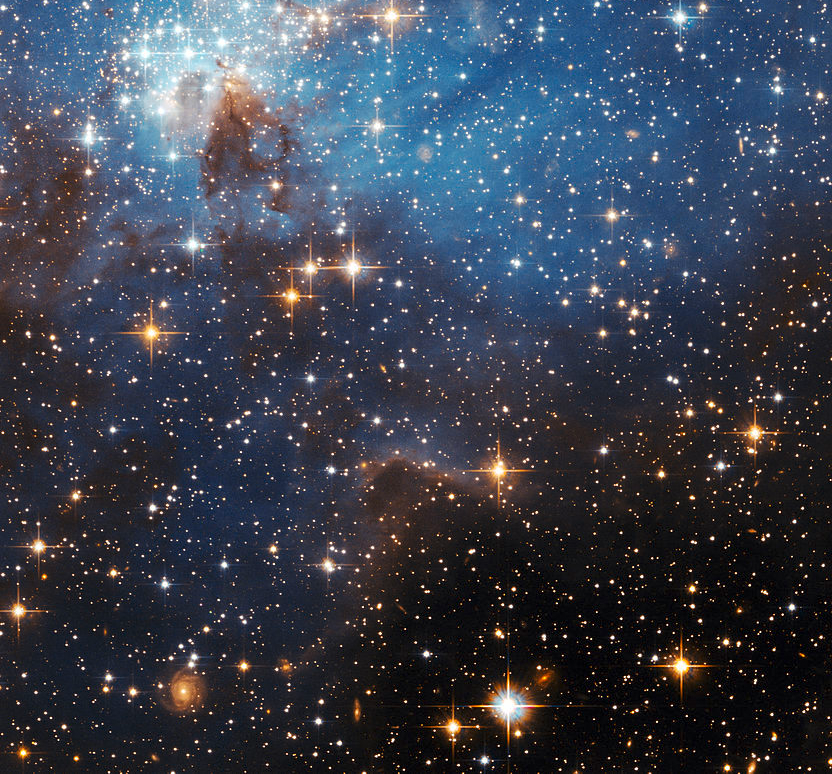
Hubble image of space. Credit: Nasa/ESA.

At first glance, the answer seems simple. ‘Inter’ means between. ‘Stellar’ refers to stars. “Easy!” you think, “Interstellar space is the part of space that exists between stars.”

Not so fast! Wouldn’t that pretty much mean that all of space is interstellar space?

For interstellar space to be something different, then there must be some defined boundary between the space near a star and the space in between stars. But what is that boundary?


Look to the solar wind!
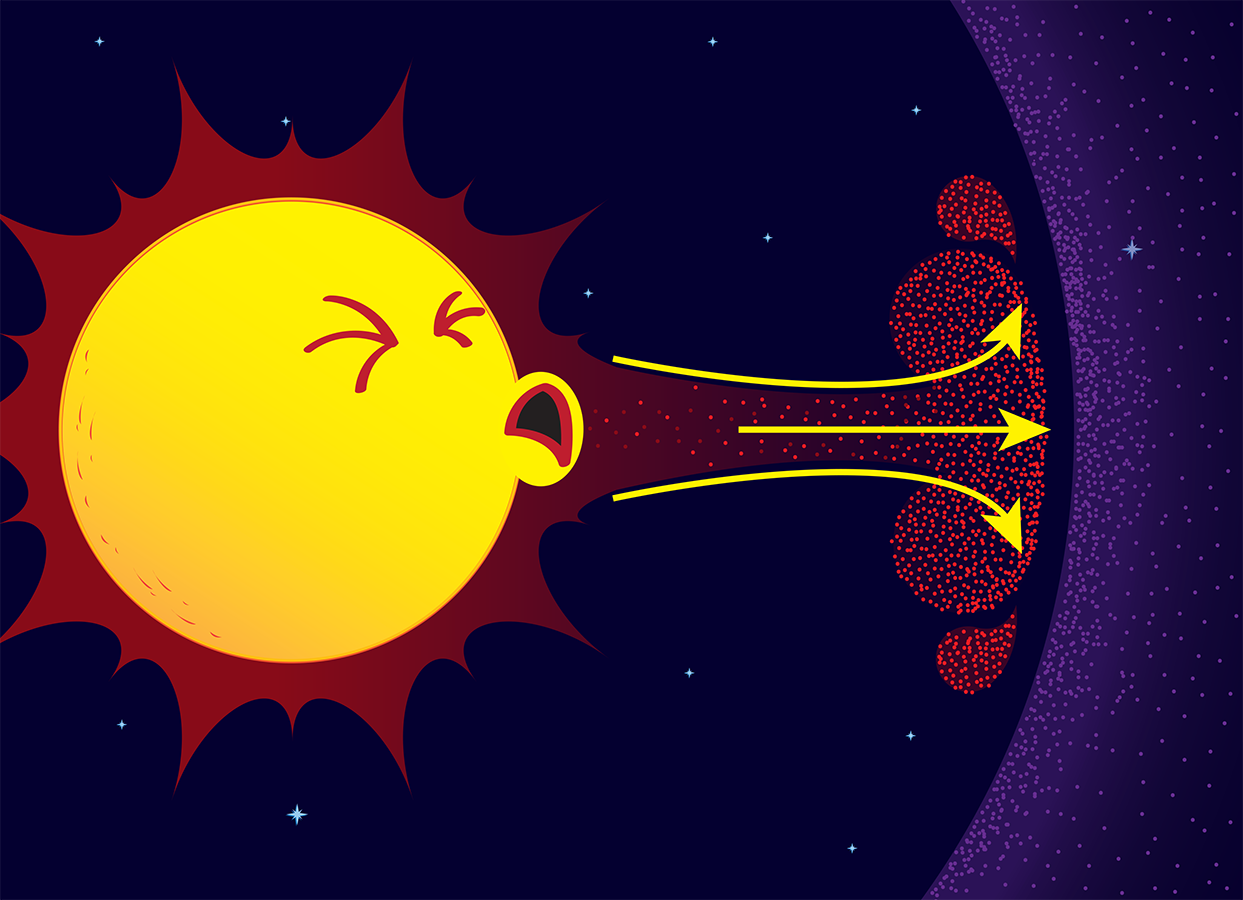
Cartoon of the Sun blowing particles into space.

The solar wind pushes against the particles of interstellar space.

Scientists define the beginning of interstellar space as the place where the Sun’s constant flow of material and magnetic field stop affecting its surroundings. This place is called the heliopause. It marks the end of a region created by our Sun that is called the heliosphere.

The Sun creates this heliosphere by sending a constant flow of particles and a magnetic field out into space at over 670,000 miles per hour. This stream is called the ‘solar wind.’

Like Earth wind, this wind pushes against the stuff around it. What it pushes against are particles from other stars. —pretty much anything that doesn’t come from our own solar system.


How would we know when we’ve arrived in interstellar space?

When it comes to the Sun it’s all about detecting the concentration and temperature of the particles around you.

Inside the heliosphere, the solar particles are hot but less concentrated. Outside of the bubble, they are very much colder but more concentrated.

Once you arrive in interstellar space, there would be an increase of “cold” particles around you. There would also be a magnetic field that does not originate from our Sun. Welcome to interstellar space!
anitmation of a cliff jumping astronaut.

Comments

Popular posts from this blog

Build a Bubble-Powered Rocket!

  Build a Bubble-Powered Rocket! Build your own rocket using paper and fizzing tablets! Watch it lift off. How high does your rocket go? Print this page for the instructions. Suggestion: Find a grown-up to do this activity with you. Materials: Paper, regular 8-1/2- by 11-inch paper, such as computer printer paper or even notebook paper. Plastic 35-mm film canister (see hints below) Cellophane tape Scissors Effervescing (fizzing) antacid tablet (the kind used to settle an upset stomach) Paper towels Water Eye protection (like eye glasses, sun glasses, or safety glasses) Hints: The film canister MUST be one with a cap that fits INSIDE the rim instead of over the outside of the rim. Sometimes photography shops have extras of these and will be happy to donate some for such a worthy cause. Keep in mind: Just like with real rockets, the less your rocket weighs and the less air resistance (drag) it has, the higher it will go. Making the Rocket You must first decide how to cut your paper. ...

Make a topographic map!

  Make a topographic map! Build your own mountain and make a topo map of it! A topographic map, or "topo map," is a way to show mountains and valleys on a flat piece of paper. Topo maps are handy and necessary for many uses, including building roads and hiking trails in the mountains. The map shows where the hills and valleys are and how steep they are. What you need: A lump of clay or Play-Doh® about the size of a coffee mug.  Piece of cardboard or large tile on which to work the clay Piece of dental floss, about 2 feet (around 60 centimeters) long Ruler Piece of plain, white paper Long pencil 2 toothpicks What to do: Put the lump of clay on the cardboard and shape a mountain about 4 inches high. Making the map is more fun if you make your mountain a little lop-sided or oddly shaped. However, the mountain should be flat on the bottom. Use the long pencil to poke two holes straight down through the center of the mountain. Make sure your two holes go all the way through the mo...

Why Does the Moon Have Craters?

  An asteroid or meteor is more likely to hit Earth because Earth is a lot bigger than the Moon, giving a meteoroid more area to hit! But we can see many thousands of craters on the Moon and we only know of about 180 on Earth! Why is that? The truth is both the Earth and the Moon have been hit many, many times throughout their long 4.5 billion year history. This view of the Moon's cratered South Pole was seen by NASA's Clementine spacecraft in 1996. Credit: NASA/JPL/USGS Where did all of Earth's craters go? The main difference between the two is that Earth has processes that can erase almost all evidence of past impacts. The Moon does not. Pretty much any tiny dent made on the Moon’s surface is going to stay there. Three processes help Earth keep its surface crater free. The first is called erosion. Earth has weather, water, and plants. These act together to break apart and wear down the ground. Eventually erosion can break a crater down to virtually nothing. Lake Manicouag...