
"See" inside a closed box!
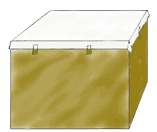
 

"See" inside a closed box!

Mystery box

Make a detailed map of an object you can't even see!

Suppose someone shows you a box and says it contains a mysterious object. Figure out what's in the box without looking or touching and the object is yours!

The box has no lid, but is covered by a piece of paper so you can't see inside. You are allowed to poke small holes in the paper with a sharp, straight stick of some kind, like a knitting needle, but you can't peek inside. How would you discover what's in the box?

Well, one way is to poke the stick straight down into the box until it touches something. Mark with your fingers how far the stick went in. Take out the stick and measure how far it went into the box. Mark that hole with that measurement. You could use numbers for the measurements, but an easier way is to use colors. For example, 5 inches deep is blue, 6 inches is purple.
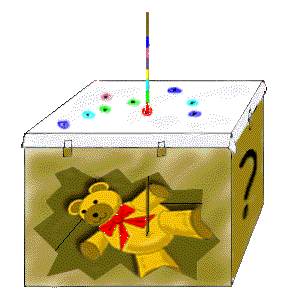
Topographical bear in box

After you have almost covered the paper with color-coded holes, you could color in the areas with same-colored holes. You would then have a topographical map of the object inside the box!

You might not be able to tell exactly what the object is even from its "topo" map. But, if you know what colors stand for what heights, you could imagine how the object might look in three dimensions.
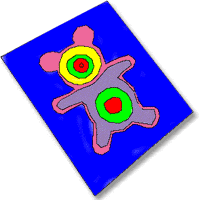
Bear topo map


Comments

Popular posts from this blog

Build a Bubble-Powered Rocket!

  Build a Bubble-Powered Rocket! Build your own rocket using paper and fizzing tablets! Watch it lift off. How high does your rocket go? Print this page for the instructions. Suggestion: Find a grown-up to do this activity with you. Materials: Paper, regular 8-1/2- by 11-inch paper, such as computer printer paper or even notebook paper. Plastic 35-mm film canister (see hints below) Cellophane tape Scissors Effervescing (fizzing) antacid tablet (the kind used to settle an upset stomach) Paper towels Water Eye protection (like eye glasses, sun glasses, or safety glasses) Hints: The film canister MUST be one with a cap that fits INSIDE the rim instead of over the outside of the rim. Sometimes photography shops have extras of these and will be happy to donate some for such a worthy cause. Keep in mind: Just like with real rockets, the less your rocket weighs and the less air resistance (drag) it has, the higher it will go. Making the Rocket You must first decide how to cut your paper. ...

Make a topographic map!

  Make a topographic map! Build your own mountain and make a topo map of it! A topographic map, or "topo map," is a way to show mountains and valleys on a flat piece of paper. Topo maps are handy and necessary for many uses, including building roads and hiking trails in the mountains. The map shows where the hills and valleys are and how steep they are. What you need: A lump of clay or Play-Doh® about the size of a coffee mug.  Piece of cardboard or large tile on which to work the clay Piece of dental floss, about 2 feet (around 60 centimeters) long Ruler Piece of plain, white paper Long pencil 2 toothpicks What to do: Put the lump of clay on the cardboard and shape a mountain about 4 inches high. Making the map is more fun if you make your mountain a little lop-sided or oddly shaped. However, the mountain should be flat on the bottom. Use the long pencil to poke two holes straight down through the center of the mountain. Make sure your two holes go all the way through the mo...

What is SOLAR WIND ?

  SOLAR WIND The solar wind continuously flows outward from the Sun and consists mainly of protons and electrons in a state known as a plasma. Solar magnetic field is embedded in the plasma and flows outward with the solar wind. Different regions on the Sun produce solar wind of different speeds and densities. Coronal holes produce solar wind of high speed, ranging from 500 to 800 kilometers per second. The north and south poles of the Sun have large, persistent coronal holes, so high latitudes are filled with fast solar wind. In the equatorial plane, where the Earth and the other planets orbit, the most common state of the solar wind is the slow speed wind, with speeds of about 400 kilometers per second. This portion of the solar wind forms the equatorial current sheet. During quiet periods, the current sheet can be nearly flat. As solar activity increases, the solar surface fills with active regions, coronal holes, and other complex structures, which modify the solar wind and cur...